Skip to content
N Nirikkhon AI Sign in

Every call audited,
not one in fifty.

A QA desk listening by hand gets through about two calls in a hundred. Nirikkhon AI transcribes all of them in Bangla and English, scores each one against your own SOP, and shows the line in the transcript that earned the score.

12 heard by a reviewer 560 taken in the week

The sample does not grow when the operation does

Two hundred agents handling forty interactions each is eight thousand conversations in a day. A desk listening by hand gets through about one per agent. Everything else carries the same regulatory exposure and none of the scrutiny.

8,000
Conversations a day, across voice, chat and email.
160
Reviewed by hand — roughly one per agent, the realistic ceiling for a manual team.
7,840
Never scored, never coached, and invisible until a complaint surfaces one of them.

An illustrative model rather than measured client data: two hundred agents at forty interactions each, against the two per cent sample a manual team can sustain. Your own volumes will differ, and the ratio is what matters.

One call, stopped at the moments that moved the score

Inbound broadband fault, 4:12, Bangla

0:19

The agent checks who they are talking to

Agent

অ্যাকাউন্টটা দেখার আগে নিরাপত্তার জন্য আপনার জন্মতারিখটা বলবেন?

Before I open the account, may I have your date of birth for security?

What the audit did with it

Yes

Verified the customer's identity before opening the account

20

The answer keeps the words that produced it. Click the timestamp in the console and the recording seeks to 0:19, so a disputed score takes about fifteen seconds to settle.
1:12

The customer's patience runs out

Customer

কাল থেকে তিনবার ফোন করেছি, কেউ কিছু করেনি।

I have called three times since yesterday and nobody has done anything.

Sentiment, turn by turn

Turn 14 of 38, the sharpest drop in the call. The same pass reads the reason the customer rang, how the call ended, and whether a cancellation was in play.

2:31

The agent commits to a time

Agent

আজ রাত এগারোটার মধ্যে ঠিক হয়ে যাবে, আমি নিজে দেখছি।

It will be fixed by eleven tonight — I am looking at it myself.

Commitment on the record

Fault cleared by 23:00, same day

Spoken at 2:31, with the agent naming themselves as the owner

Promises, dates and figures come out of the call as their own record, so a supervisor can see what was undertaken without listening to it.

3:24

The close, one step short

Agent

আর কোনো সাহায্য লাগবে? ধন্যবাদ, ভালো থাকবেন।

Anything else I can help with? Thank you, take care.

What the audit did with it

No

Offered the matching recharge before closing the call

15

The data had run out, and the pack that fixes it was never mentioned. This is the kind of miss a two-percent sample never sees, and it is worth fifteen points on every call it happens in.

4:05

The call ends and the scorecard closes

Scored against
Broadband — fault handling
Questions answered
14 of 14
Time to score
under two minutes
77 Borderline

Identity handled correctly and the fault explained plainly. The recharge was never offered, and the customer had already called three times before this one.

A repeat contact inside seven days, so your rules raise it for a supervisor to look at. A question marked fatal would have taken the whole call to zero instead.

Not a concept — a working console

These are screens from the running product, on a tenant loaded with demonstration data. Nothing here is a mock-up.

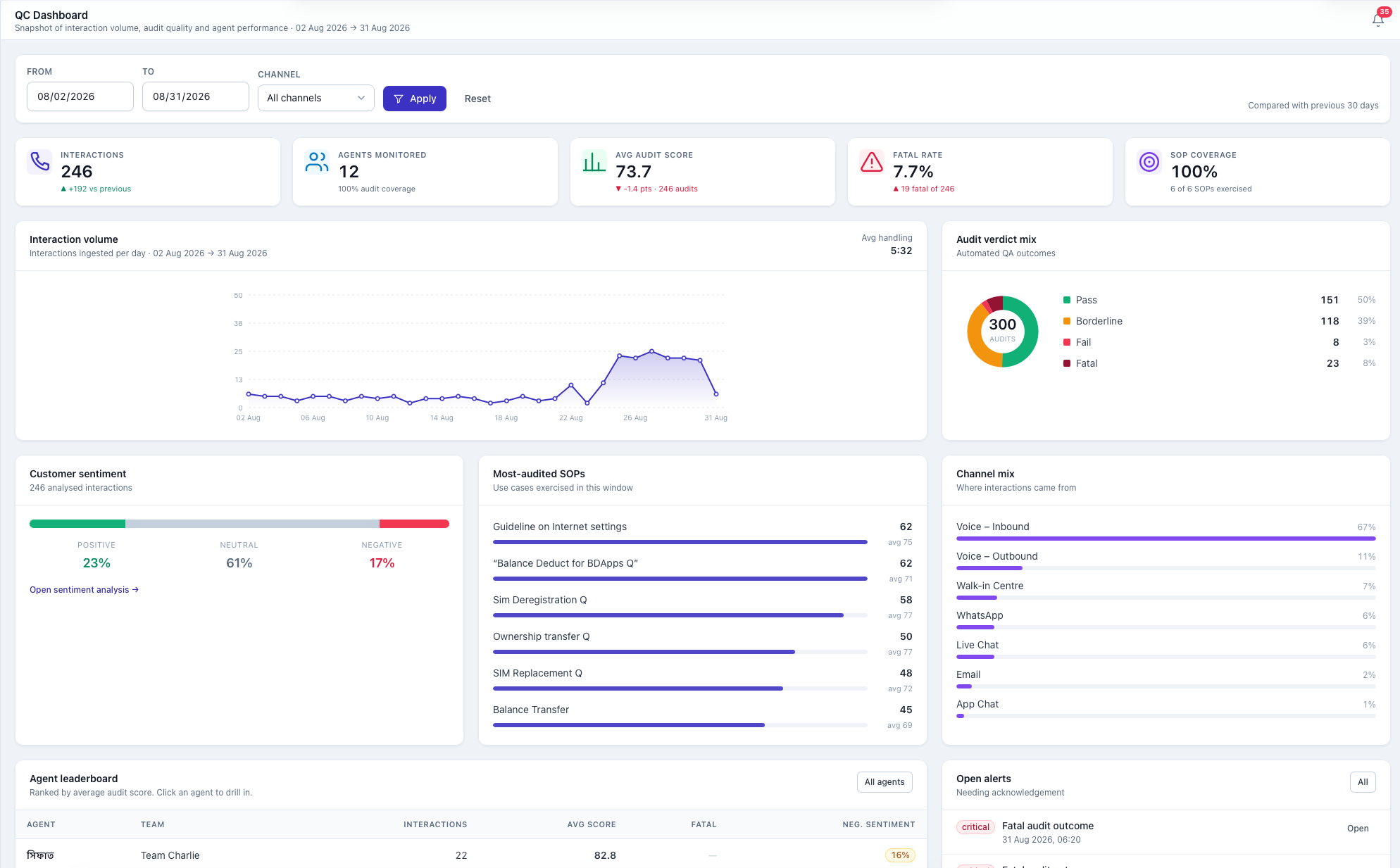
The QC dashboard: interaction volume, audit verdict mix, customer sentiment, most-audited SOPs, channel mix and the agent leaderboard.
Volume, verdict mix, sentiment, most-audited SOPs and the leaderboard, over whatever window you filter to.

Five stages, each one retried on its own

A recording lands and the queue takes it from there. When a stage fails it retries by itself without redoing the stages before it, and every job is visible while it moves.

  1. Transcription

    Who spoke, when, and for how long, with hold and talk time split out.

  2. Classification

    Why the customer called, how it ended, and whether a sale or a cancellation was in play.

  3. Analytics

    Sentiment turn by turn, plus the promises, dates and figures the agent committed to.

  4. Audit

    The weighted scorecard, answered against your SOP with the evidence attached.

  5. Summary

    A few factual lines a supervisor can read instead of the whole transcript.

Afterwards it looks for repeat contacts from the same customer and runs your alert rules over the result. A recording already ingested is recognised by its contents and skipped, so re-scanning a folder is safe.

What your team works in

Getting calls in

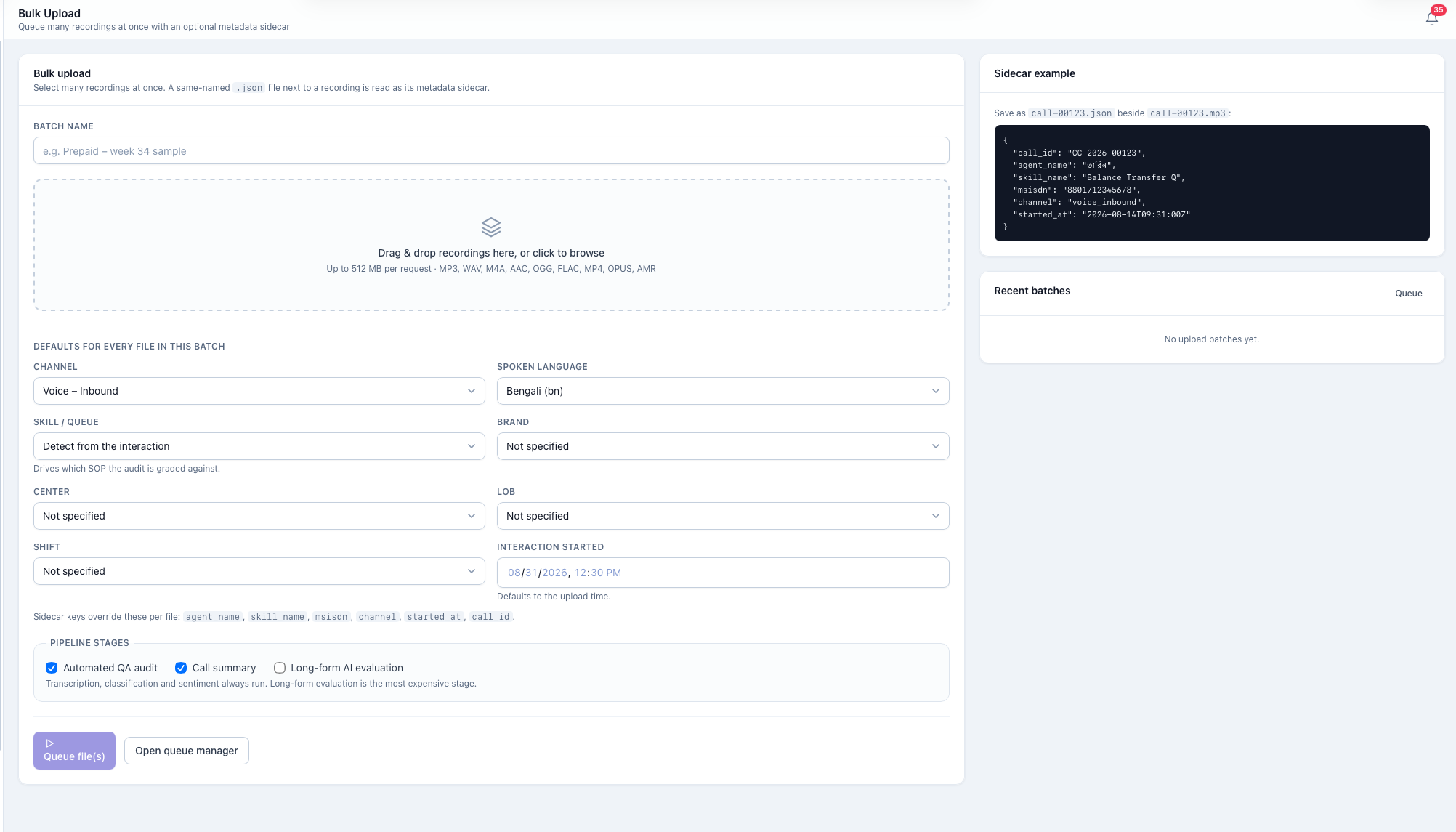
  • One recording at a time, or a whole folder with a metadata file beside each file
  • A watched directory on the server: drop files in, they queue themselves, and the originals move to a done folder
  • Chat and email threads, pasted or uploaded as text
  • A processing queue you can watch, with per-stage retries and stale jobs reclaimed automatically

Quality

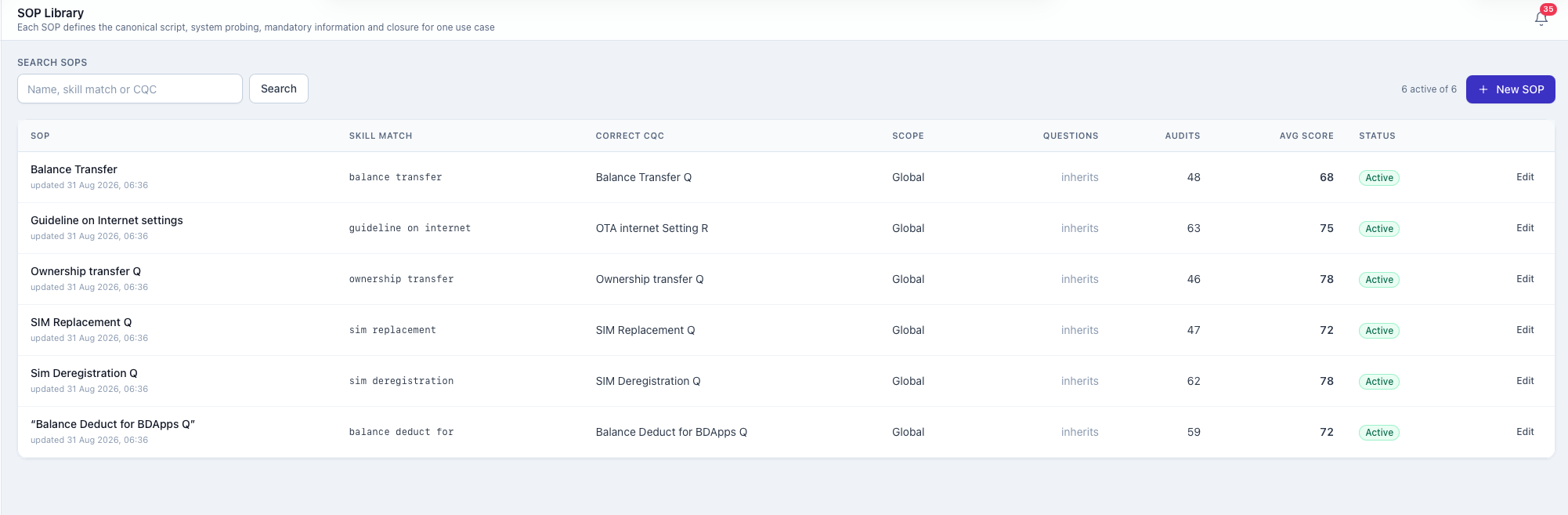
  • An SOP library of scripts, probing checkpoints, mandatory information and fatal notes, matched to each call by skill
  • Weighted yes/no forms, where "not applicable" earns full weight and a fatal answer zeroes the call
  • An audit workspace with the recording and transcript in step, and click-to-seek timestamps
  • Reviewers re-score inline, and the call is rescored on save
  • Sampling rules — so many calls per agent per period, spread across shifts, with the gaps named
  • Calibration: how far the automated score sits from your reviewers', question by question

What you learn from it

  • A dashboard of volume, verdict mix, sentiment, SOP usage and the leaderboard
  • Agent profiles: score trend, pass rate per parameter, skill mix and a coaching brief
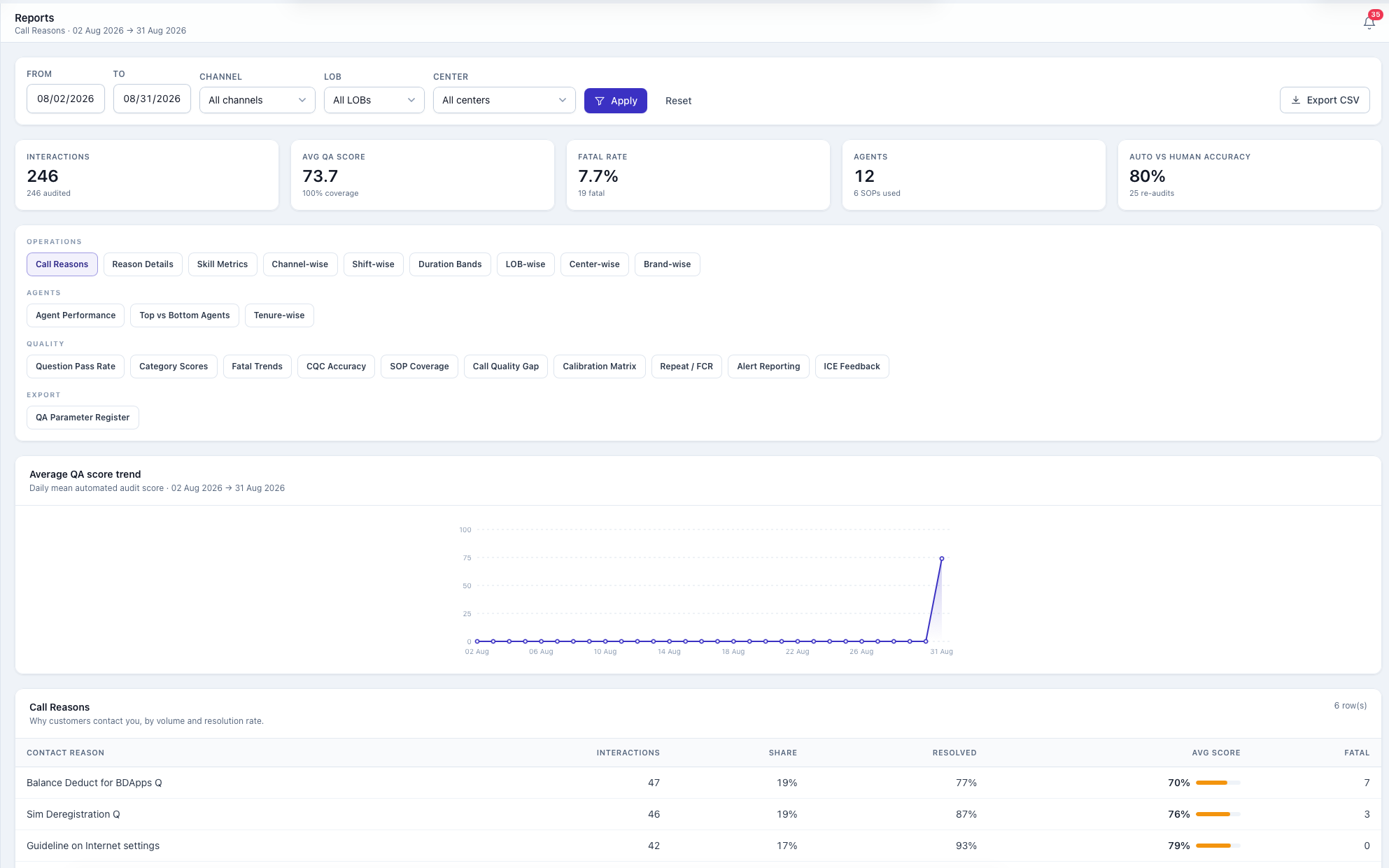
  • 23 reports across operations, agents and quality, every one exportable as CSV
  • Training needs worked out from audit data, assigned, then measured again afterwards
  • Alerts for regulatory wording, abuse, escalation language, long calls and fatal outcomes, with thresholds your own staff can edit

Running it

  • Users placed in a centre, a team and a line of business
  • Roles with a full permission matrix, and a data scope — whole organisation, own centre, own team, own records — that every query obeys
  • Your own reference data: centres, teams, lines of business, skills, shifts and brands
  • An audit trail of every administrative action and every sign-in
  • Password policy, lockout and session timeout you set yourself

Built for operations where a bad call has a cost

Regulated, high-volume and multi-site environments — anywhere quality has to be evidenced rather than asserted.

Telecom customer service

  • SIM, VAS, billing and deregistration use cases
  • Prepaid, postpaid and corporate lines of business
  • Per-SOP scoring across a large agent population

Banking and financial services

  • Mandatory disclosure and consent checkpoints
  • Mis-selling language flagged as a fatal outcome
  • A full audit trail for every score and re-score

Walk-in service centres

  • Counter conversations scored on the same rubric
  • Branch and centre comparison on like-for-like scores
  • Shift-wise coverage, including the night gap

Chat, email and WhatsApp

  • Written channels ingested directly as transcripts
  • Tone and completeness scored, not just resolution
  • One quality view across voice and text

Outsourced and BPO operations

  • Vendor performance measured on your own rubric
  • Role-based data scope per centre, team or vendor
  • Evidence attached to every SLA conversation

Bot and IVR quality

  • Voice and chat bots scored like human agents
  • Containment failures and hand-off quality exposed
  • Prank and silent contacts identified automatically

From SOP documents to a live queue, one guided path

Your SOPs, scorecard, roles and reference data are configured with you, then validated against calls you already know the answer to.

  1. 01

    Discover

    Map channels, volumes, skills, centres and the QA rubric you already run.

    An agreed rollout plan

  2. 02

    Configure

    Load the SOP library, weighted questions, fatal rules, roles and data scope.

    Your rubric, live

  3. 03

    Connect

    Recording source or watched folder, reference data, branding and model settings.

    Interactions flowing

  4. 04

    Calibrate

    Run calls you have already scored, compare automated against human, and tune prompts and thresholds.

    Scores you trust

  5. 05

    Go live

    Roll out by centre or channel, train QA and team leaders, review coverage monthly.

    Ongoing optimisation

Built to run inside your network

Nothing calls out for assets
Fonts, scripts and stylesheets are served by the application itself. No CDN to allow through the firewall.
Bangla first
Every font stack ends in a Bengali face, so transcripts render the same on a locked-down desktop as they do here.
Your name on it
Logo, colours, typography and the words the product uses for its own nouns — all changed in the console, with no rebuild.
More than one operator
Each tenant keeps its own users, SOPs, scorecard, prompts and data, and answers on its own hostname.
Your choice of model
Gemini, OpenAI or OpenRouter, set per tenant and per stage. A built-in offline provider runs the whole thing with no network at all.
Every prompt is yours to edit
Transcription through coaching, editable in settings with the previous version kept. Changes apply to the next call, never to results already recorded.

Bring us ten calls you already know

The fastest way to judge this is to let it score conversations your own QA team has already audited, then compare line by line.

  1. Share your rubric

    Your SOPs, scorecard, fatal rules and a sample of recordings or chat transcripts.

  2. Watch it score them

    A walkthrough on your own calls — evidence, timestamps, verdicts and the reports that follow.

  3. Compare against your QA

    Variance and agreement measured against your own reviewers, question by question, in the calibration view.

  4. Take the proposal

    A rollout plan and commercial terms priced against your actual operation, not a feature tier.